
Type
Doc. Code
Doc. Title
In this session, members had the opportunity to discuss with the motion’s proposers and members. The motions discussed were:
We hosted two identical sessions to accommodate different time zones.

The FSC Global Membership Meeting 2020 presented a general overview and highlights of the achievements in 2020, and general priorities and key issues for 2021.
In order to accommodate several time zones and enable the participation of our members from all regions, the session was held in the morning and repeated in the afternoon. Both sessions ran live and contained the same discussions.
Over 400 registered participants from around the world joined the presentations and subsequent discussions. You can find the meeting recordings and presentations below.

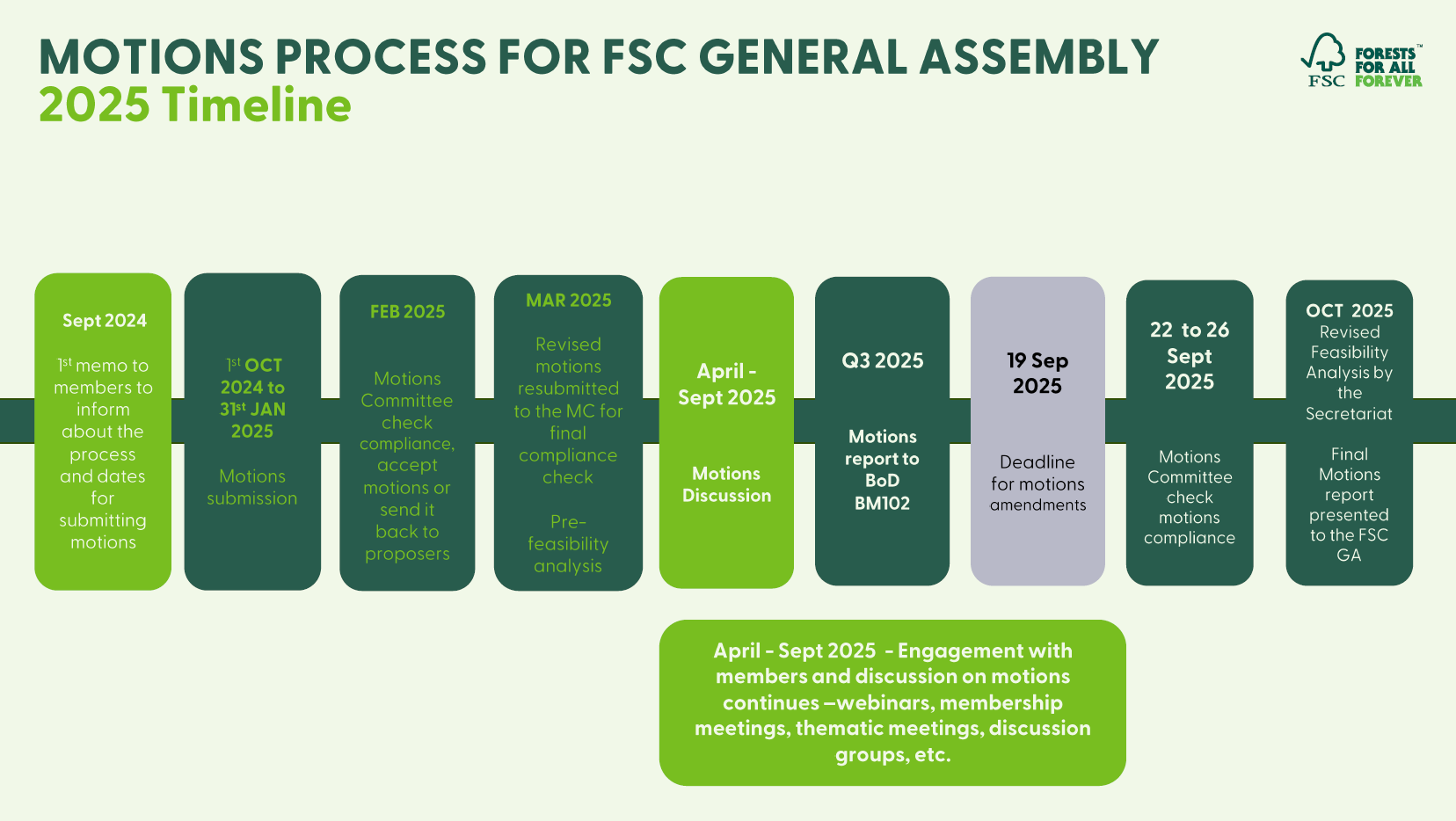
During this session, we will present the motion submission schedule and we will have a demo on how to submit a motion through the FSC Motions platform.

We hosted two identical meetings to allow the participation of our global membership. These took place via Zoom.
You can watch the recordings of the main plenary session here:

The FSC general assembly is FSC’s highest decision-making body, attracting hundreds of participants from indigenous people, environmentalists, business and others in FSC membership. The GA is traditionally held every three years, however the general assembly planned for 2020 was re-scheduled to take place in two parts at the 2021-2022 general assembly. The first part took place virtually in 2021 and the second part will take place as a hybrid event with in-person and online components.
The in-person part of the FSC general assembly is planned to take place in Bali, Indonesia. Learn more about what happens at the general assembly.


Over 200 participants from Latin America joined the presentations and subsequent discussions.
You can find the meeting recording and presentations below.
Scroll down to access the recording of the sessions.


The Forest Stewardship Council (FSC) has reached an important milestone with the approval of the FSC core labour requirements within the Chain of Custody standards. With this new step, the principles of the International Labour Organisation’s (ILO) Core Conventions and the ILO Declaration on Fundamental Principles and Rights at work (1998) are integrated into FSC’s Chain of Custody standards.

WAZA seeks to boost the use of sustainably sourced products amongst its members.

On 26 and 27 November, the Forest Stewardship Council Regional Meeting of Indigenous Peoples was held in “Ciudad del Saber” (Panama) in a climate of brotherhood and cordiality.

FSC Ukraine and other Ukrainian organizations jointly organized an international research conference to address challenges faced by the Ukraine forestry sector, and also to explore the opportunity FSC certification represents for the country and the CIS region. The participants also developed a resolution addressed to the Ukrainian government calling for a reform of the national forest sector. The resolution includes the recommendation to use FSC forest management (FM) certification as best practice.

As demand for certified forest products increases alongside efforts to decarbonize the economy and mitigate climate change, understanding the economic benefits of forest certification is critical.
A study published in Frontiers in Forests and Global Change explored this question.

FSC, the Swiss Federal Institute of Technology Zurich (ETH), the French Agricultural Research Centre for International Development (CIRAD), the University of Liège and Biotope are pleased to announce their collaboration to join the global discussion on forests, particularly forest landscapes, forest climate, forest biodiversity and forest peoples’ resilience.

On this International Women’s Day, take a look at how the Forest Stewardship Council (FSC) is exploring diversity and gender equity in sustainable forestry

The Forest Management Groups standard (FSC-STD-30-005) is the first forest solution delivered by New Approaches team and has been revised and approved by the FSC International Board of Directors on November 19, less than two years after the establishment of the working group in charge of the revision.